Pearson Edexcel · GCSE · Business
Course version: 1BS0 · Version from Sept 2017
How businesses compete internationally: ● the use of the internet and…
Full specification wording
Business and globalisation: How businesses compete internationally: ● the use of the internet and e-commerce ● changing the marketing mix to compete internationally.
Businesses compete internationally by leveraging the internet and e-commerce to reach global markets without the need for physical stores.
Checked against the Pearson Edexcel 1BS0 specification (opens in a new tab) on .
- Point 3 of 3
Study notes
From the checked teaching notes for this specification point.
The idea
Businesses compete internationally by leveraging the internet and e-commerce to reach global markets without the need for physical stores. E-commerce allows 24/7 sales, reducing overheads and enabling targeted digital advertising to international customers. However, to succeed, businesses must adapt their marketing mix (Product, Price, Place, Promotion) to suit local preferences. For example, a product might need altering to meet local safety regulations or cultural tastes. Pricing strategies must account for exchange rates, tariffs, and local income levels. Promotion requires translating campaigns accurately and respecting cultural norms, while Place involves establishing reliable international distribution channels.
What earns the marks
- E-commerce enables businesses to access a global customer base with lower start-up costs compared to physical expansion.
- Products may require modification to comply with foreign legislation or to appeal to local cultural preferences.
- Pricing decisions must factor in additional costs such as shipping, import tariffs, and fluctuations in currency exchange rates.
- Promotional materials must be carefully translated and culturally adapted to avoid causing offence or misunderstanding in new markets.
- Place strategies must ensure efficient international logistics and distribution networks to deliver goods reliably.
Common mistakes and how to put them right
Assuming e-commerce guarantees international success without extra costs.
Put it right: Recognise that international e-commerce still incurs shipping, tariff, and website localisation costs.
Stating the marketing mix only involves changing the product.
Put it right: Explain that all four elements (Product, Price, Place, Promotion) may need adapting for international markets.
Believing that a successful domestic promotional campaign will automatically work abroad.
Put it right: Acknowledge that cultural differences and language barriers require tailored promotional strategies.
Exam tips
- When evaluating international expansion, weigh the low cost of e-commerce against the high cost of adapting the marketing mix.
- Use the context of the business to decide which element of the marketing mix needs the most adaptation, such as food products needing significant product adaptation.
- Always link changes in the marketing mix to the potential impact on sales, costs, or brand reputation in the target country.
Try the lesson
The start of the Business and globalisation: How businesses compete internationally: ● the use of the internet and e-commerce ● changing the marketing mix to compete internationally. lesson, made from checked teaching notes for this specification point.
Have a go first
How can a business use e-commerce to compete internationally?
Listen
Businesses compete internationally by leveraging the internet and e-commerce to reach global markets without the need for physical stores. E-commerce allows 24/7 sales, reducing overheads and enabling targeted digital advertising to international customers. However, to succeed, businesses must adapt their marketing mix (Product, Price, Place, Promotion) to suit local preferences. For example, a product might need altering to meet local safety regulations or cultural tastes. Pricing strategies must account for exchange rates, tariffs, and local income levels. Promotion requires translating campaigns accurately and respecting cultural norms, while Place involves establishing reliable international distribution channels. A strong answer earns marks for these points. E-commerce enables businesses to access a global customer base with lower start-up costs compared to physical expansion. Products may require modification to comply with foreign legislation or to appeal to local cultural preferences. Pricing decisions must factor in additional costs such as shipping, import tariffs, and fluctuations in currency exchange rates. Promotional materials must be carefully translated and culturally adapted to avoid causing offence or misunderstanding in new markets. A common slip: Assuming e-commerce guarantees international success without extra costs. Instead, Recognise that international e-commerce still incurs shipping, tariff, and website localisation costs. Exam tip: When evaluating international expansion, weigh the low cost of e-commerce against the high cost of adapting the marketing mix.
See it
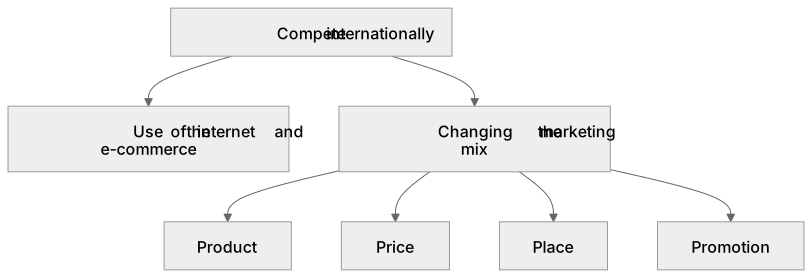
Label the diagram
Some boxes have lost their names. Pick the right name for each number.
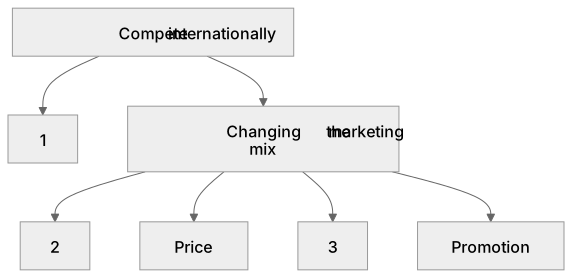
1Box 1
2Box 2
3Box 3
There is more to this lesson
The full lesson goes on to check your understanding and help you earn the marks. Create a free account to carry on, with your progress saved.
A week of Premium from your first lesson · Then the free plan continues · No card, no charge
Test your understanding of Business and globalisation: How businesses compete internationally: ● the use of the internet and e-commerce ● changing the marketing mix to compete internationally.
Active recall beats re-reading. Take an instant quiz now to test what you’ve learned and lock it into long-term memory.
A week of Premium from your first lesson · Then the free plan continues · No card, no charge